Click anywhere or press ESC to close
Field Operations Command — Est. 1949
Command. Conceal. Contain.
The year is 1949. Strange lights have been reported over three continents. Governments are asking questions they don't want answers to. You have been given a budget, a basement, and a facility full of people who officially don't exist.
ShadowOrg is a Cold War-era secret organisation management game. Build your base. Deploy operatives. Track anomalies. Intercept the unexplainable — and make sure the public never finds out it happened.
Monitor the world in real time. Scramble intercept teams. Deploy undercover agents. Every case site is a clock ticking toward exposure.
Manage your facility, personnel, and resources. Feed your staff. Keep morale from collapsing. 43 people in a bunker is not a simple equation.
Recovered materials. Recovered personnel. Recovered theories. The research tree is not a ladder — it is a web of things you can never quite unsee.
No jump scares. No monsters in corridors. The horror is earned — the slow accumulation of facts that should not be possible. Your analysts will not handle it equally well.
Every anomaly eventually demands boots on the ground. Ground missions are a full three-phase operation — from approach to extraction. Your agents are not soldiers. They are specialists. Use them accordingly.
Drive your vehicle or pilot your helicopter across a fully 3D map. Approach matters — your entry point shapes everything that follows.
Disembark and move on foot. Avoid civilians. Talk your way past police. Scout the target. One wrong move and the quiet ends.
Turn-based, fully 3D. Place snipers on rooftops. Suppress and capture. Destroy cover. Lockpick doors or blow them open. Every decision costs something.
Agents carry Traits and Perks — good ones and bad ones. They level up. They have limits. Know your people before you put them in the field.
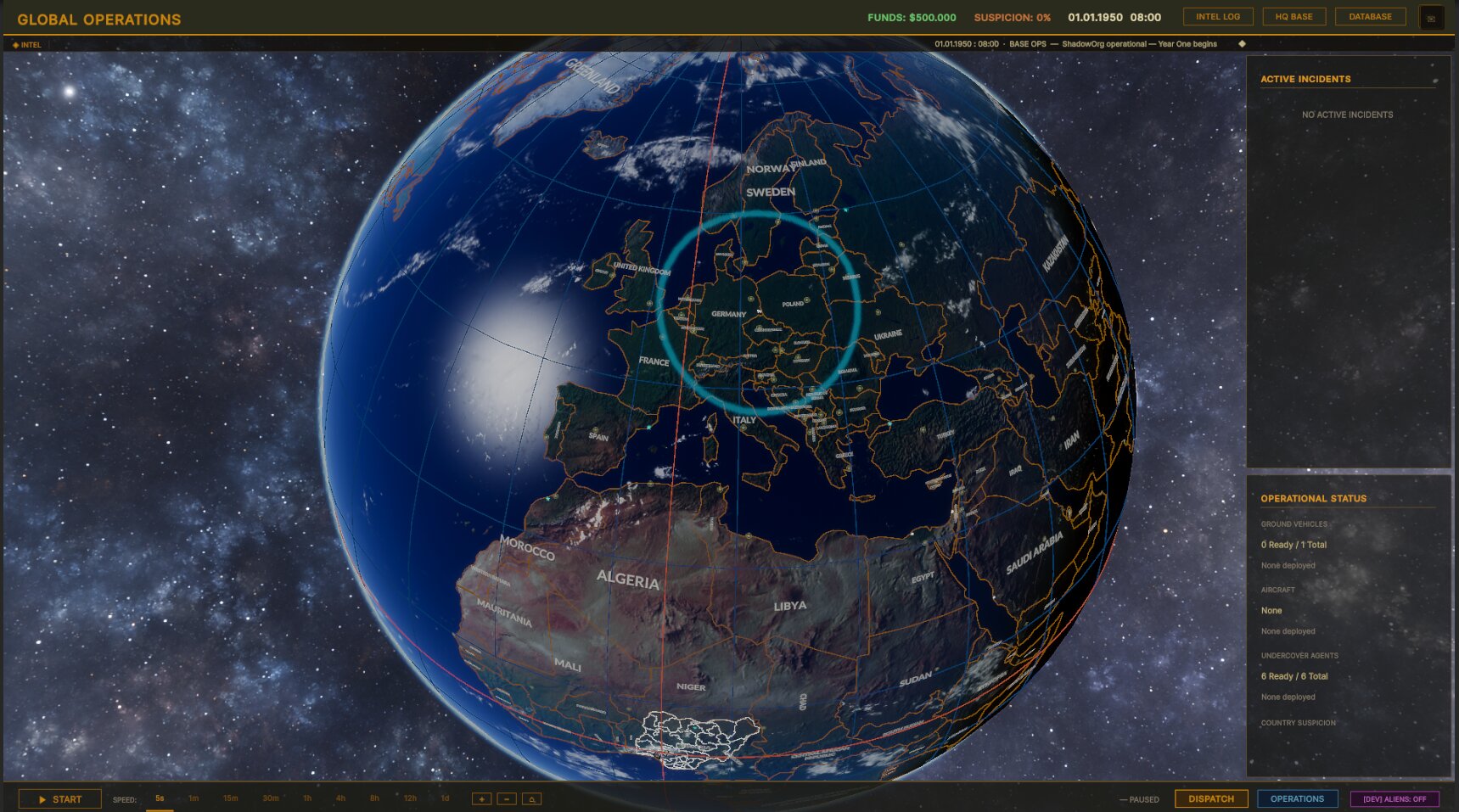 Globe Layer — Strategic Overview
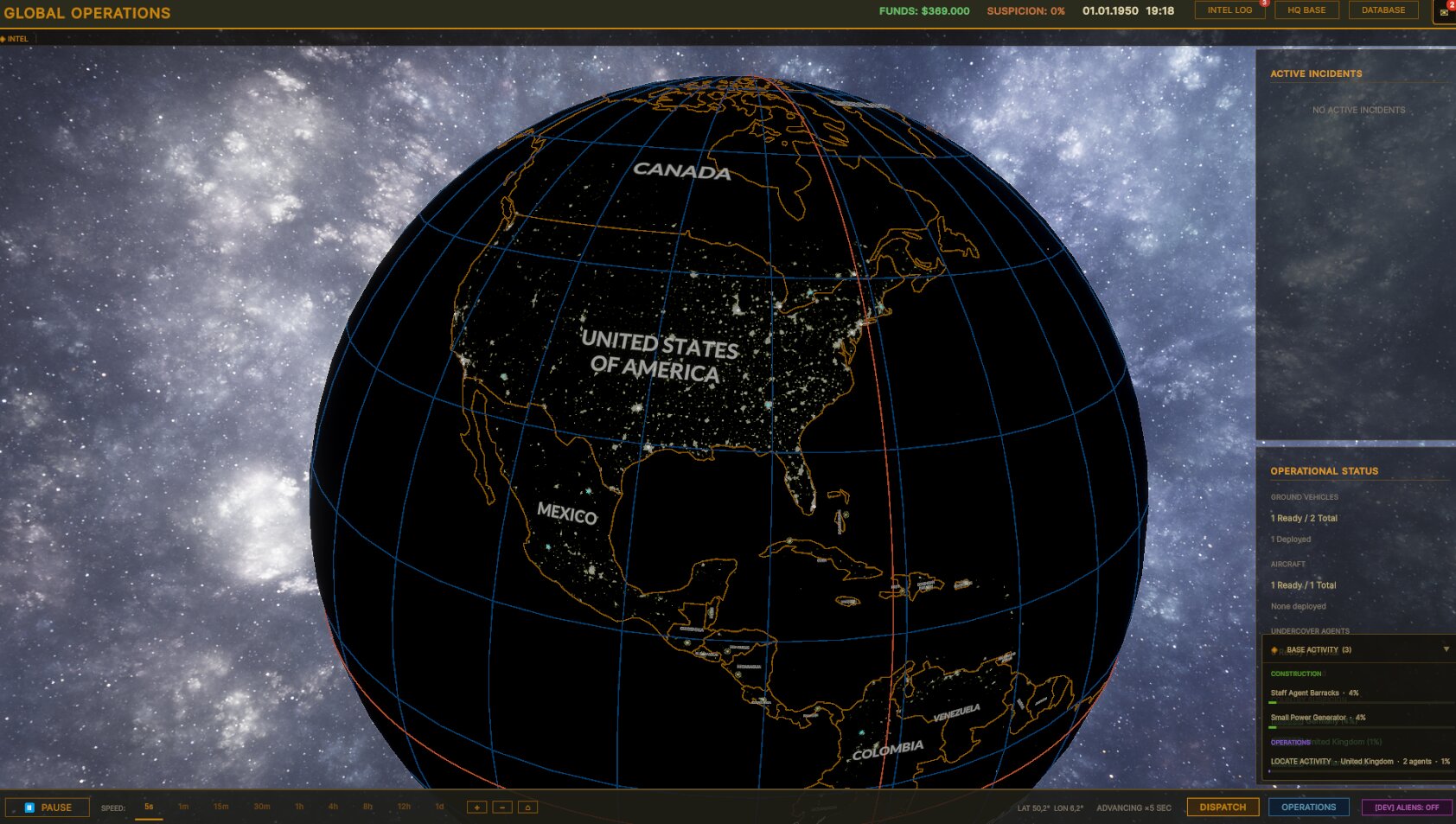 Globe Layer — Detail View
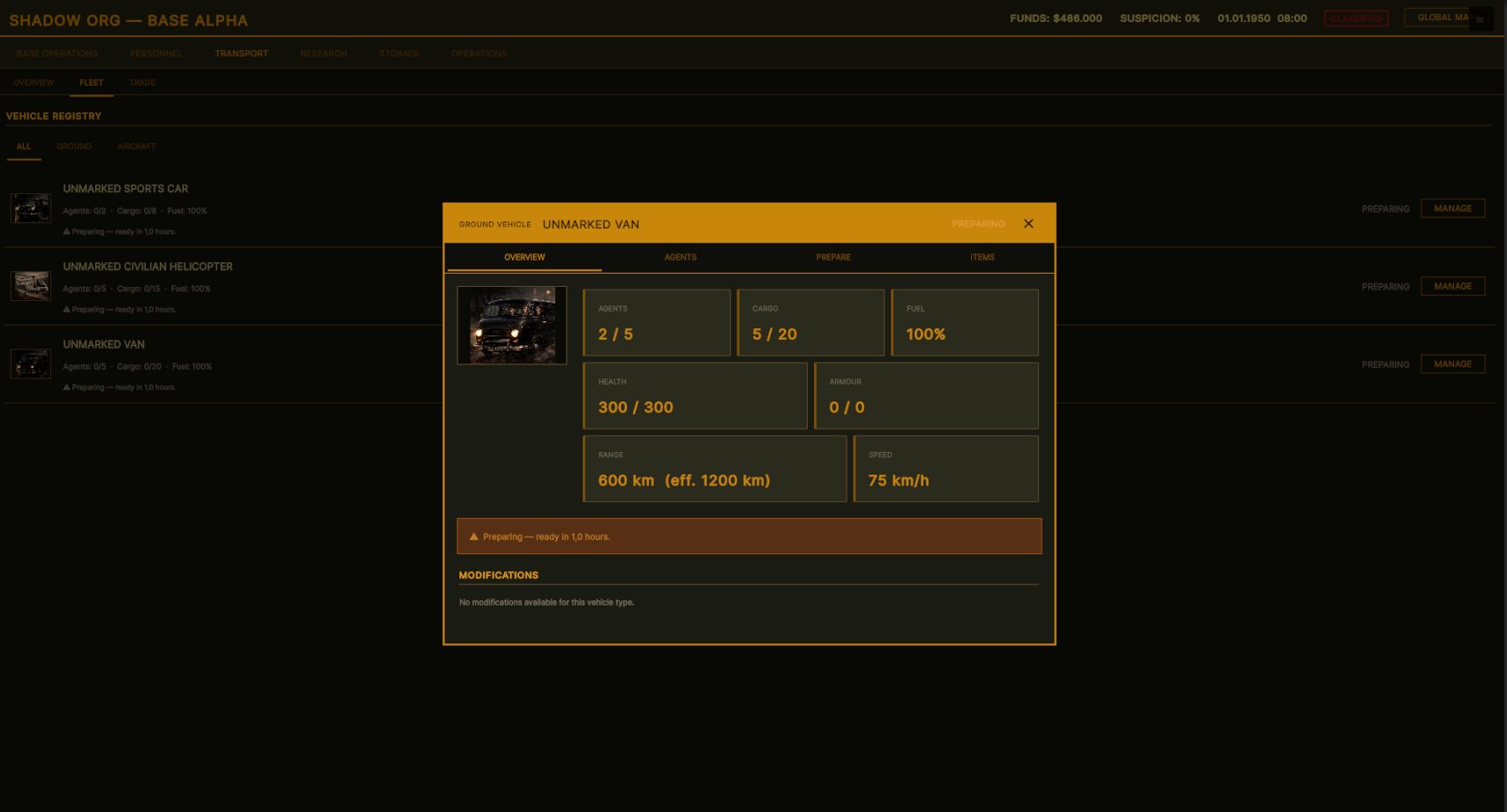 Base Management
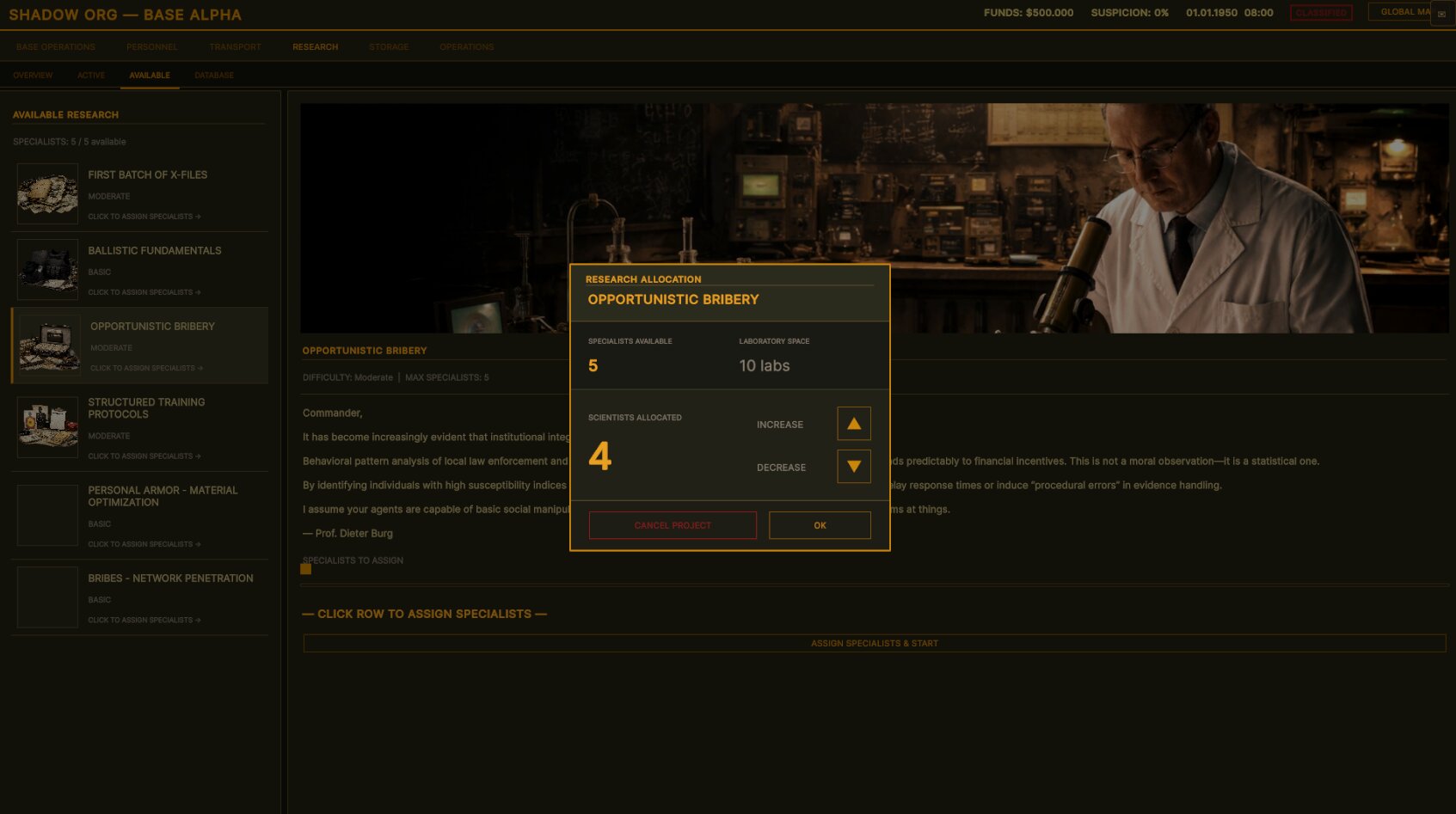 Research Tree
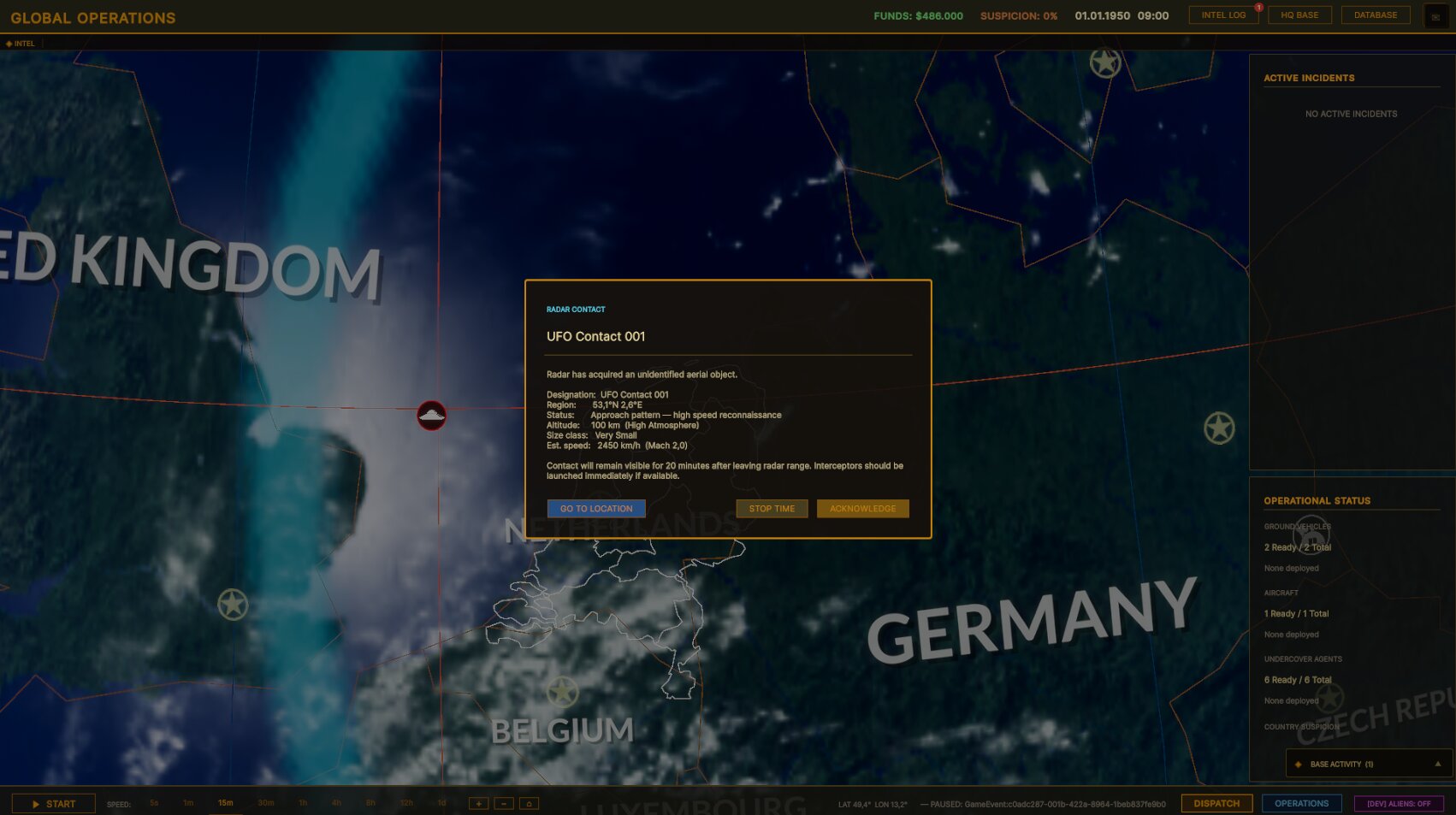 UFO Contact
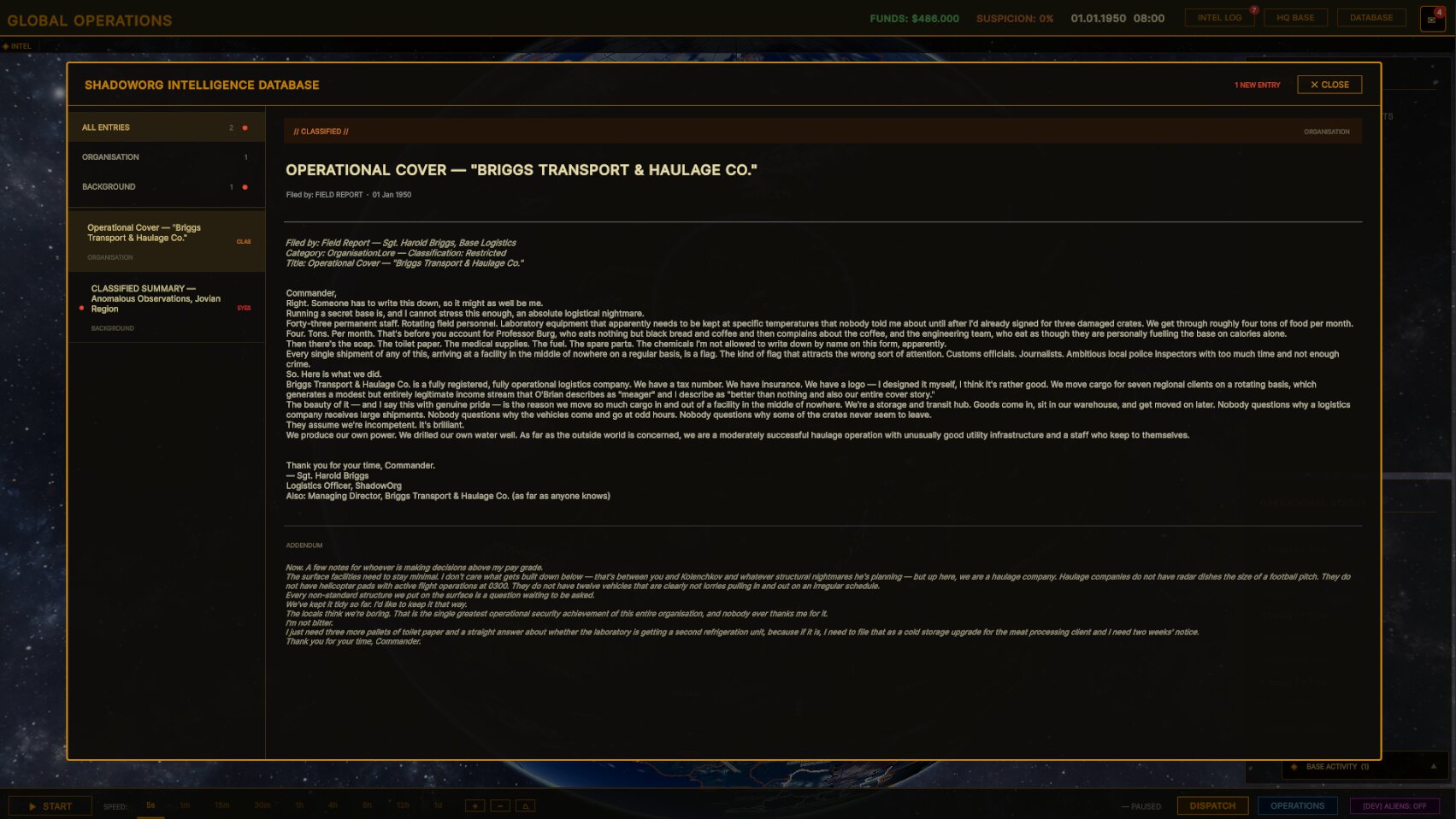 Database Entries
PERSONNEL FILES — ADVISORY DIVISION
Your advisors communicate through written memos delivered to your inbox — but they also speak. Each advisor is fully voice acted, and will brief you, warn you, and react to events as missions unfold. They have 3D models and can appear in person during special missions — if you unlock them, and if your playthrough takes you there.
"This material was not made. It was manufactured at a scale and precision that renders every industrial process we currently operate effectively obsolete. We cannot reproduce it. We can adapt it. I recommend we begin immediately."
Precise. Dry. Defensive. Never speculates beyond the data. Spent seventeen years being right about things nobody wanted to hear. He has not forgiven the evidence for that.
"The power capacity is the first problem. It is always the first problem. I need: one additional generator unit, underground routing for the secondary circuit, and six weeks. In that order. After that we can talk about the rest of the base."
Direct. Pragmatic. Blunt. Built things that were not supposed to be possible, under conditions that were not supposed to be survivable. He does not express enthusiasm. He expresses readiness.
"I won't pretend the circumstances of my appointment were entirely comfortable. I spent twenty-two years working toward a command like this one. The Council decided otherwise. I've made my peace with it. What matters is the mission."
Warm. Measured. Honest about stakes. The most frightening character in the game when he is genuinely afraid — he is too good at managing his affect for anyone to mistake ordinary concern for real fear.
"The incisions are patterned. Repeating arcs and lines, consistent across all seven subjects examined to date, aligned with major neural pathways from the posterior cortex to the brainstem. This is not anatomy as a guide. This is anatomy as a target."
Careful. Still. Plain-spoken. The gap between what she says and what she leaves unsaid is where the horror lives. She is not cold. She is controlled. There is a difference, and it matters.
"The locals think we're boring. That is the single greatest operational security achievement of this entire organisation, and nobody ever thanks me for it. I'm not bitter. I just need three more pallets of toilet paper."
Aggrieved. Dry. Permanently. He is the operational conscience of the base — the person who tracks the gap between what the organisation believes it's doing and what it's actually doing. He is the only advisor who is funny. He does not intend to be.
"Commander. The Council has reviewed the Q1 operational summary. The case site evidence yield is below projection. The Council notes that interceptor procurement remains contingent on demonstrated research progress. The current trajectory suggests this milestone will not be reached within the projected window. Adjust accordingly. The Council."
They do not have individual members in the player's narrative. They are a collective voice — formal, institutional, and carrying the weight of authority without warmth. Their communications feel like receiving a letter from a very polite threat.
SELECT DOCUMENTS — PARTIAL RELEASE AUTHORISED
Preamble — This document consolidates observation reports submitted independently by ████████ facilities across four separate national programmes between ████████ and ████████. The sources have been anonymised at the request of the contributing governments, several of whom are not aware that their reports have been shared with this body.
What follows is a factual summary. I have deliberately excluded interpretation. The facts are sufficiently disturbing without my assistance.
Beginning in ████████, multiple high-powered observation stations — operating independently, for unrelated purposes, under separate national programmes — recorded anomalous object signatures in the vicinity of Jupiter.
The objects were not immediately classified as anomalous. Initial assessments attributed the signatures to instrument error, atmospheric lensing, or uncharted debris. These explanations were logged, filed, and largely forgotten.
They were retrieved from those files when a second round of observations, conducted by a different facility in a different country using different equipment, produced results that were — and I use this word with full awareness of its implications — identical.
At that point, the assessments were escalated. Quietly. Very quietly.
The primary objects — hereafter designated TYPE-LARGE for the purposes of this document — were observed in stable positional relation to Jupiter for a period of no less than ████████ months. Whether they arrived during the observation window, or had been present prior to it, cannot be determined with certainty.
Light from Jupiter's orbital region reaches Earth after a delay of between thirty-three and fifty-three minutes, depending on relative planetary positions. Any activity observed was therefore not simultaneous with observation. How long TYPE-LARGE objects had been present before our instruments pointed in the correct direction, at the correct time, with sufficient resolution to detect them — that question does not have a comfortable answer.
They may have been there for some time.
On ██ separate occasions across the consolidated observation period, smaller objects were recorded departing the TYPE-LARGE objects and moving on trajectories consistent with approach toward the inner solar system.
Toward us, in simpler terms.
The smaller objects — TYPE-SMALL — were not tracked beyond ████████ due to instrument range limitations. Whether they completed their approach, altered course, or achieved destinations within our solar system is not confirmed by this dataset.
It is, however, consistent with certain categories of subsequent terrestrial report that this office does not have clearance to discuss in this document.
The sensitivity of this summary derives partly from its content, and partly from its sources.
The observations described above were recorded, in whole or in part, by facilities operated under the scientific programmes of ████████, ████████, and ████████. These parties are not, in the broader geopolitical context, inclined toward information sharing. The fact that their independent observations produced convergent conclusions required several layers of back-channel diplomacy to confirm.
None of the contributing parties have made their findings public. None intend to.
The reasons given vary. The underlying reason is uniform: none of them know what to say. A government that announces the observation of large structured objects near Jupiter, deploying smaller objects toward Earth, without any understanding of what those objects are, what they want, or whether the announcement will provoke a response from the objects themselves — that government is not in an enviable position.
Silence is, for the moment, the consensus strategy.
This office notes, for the record, that silence is not the same as safety.
The installation now designated as primary ShadowOrg operational headquarters was originally constructed as a hardened nuclear contingency facility during ████████. Its location was selected for geological stability, distance from population centres, and access to sufficient natural water to sustain independent operation.
It has been expanded and partially refitted over the preceding ████████ months using Council-allocated resources. The work was conducted under commercial cover. It is functional. It is not, by any measure this analyst would apply, finished.
The facility was brought into active operation earlier than originally planned. The Jupiter observations were a contributing factor in that decision. The Council determined that the acceleration of the programme timeline was preferable to the alternative, which was waiting until everything was ready.
Everything, in this analyst's experience, is never ready.
The appointment of the facility commander has been finalised by Council vote. The outcome was not, within certain circles, expected.
General Robert O'Brian was the widely anticipated selection. His record is exceptional. His advocacy for this programme was instrumental in securing Council support. He accepted the outcome of the vote with what this analyst can only describe as professional grace, which speaks well of him.
The Council's reasoning for their selection has not been formally disclosed. It rarely is.
What can be said is this: the individual appointed brings a profile considered, by those with full access to the relevant files, to be suited to the specific nature of what is coming. Not merely the administrative and strategic demands of running an organisation of this kind — O'Brian would have been more than adequate for those.
But for what comes after.
This analyst is not cleared to elaborate further. The relevant files are held at Council classification level and above.
The new Commander has been briefed on the Jupiter observations. They have been given this document. They are now sitting where O'Brian expected to sit.
I hope the Council is right about them.
For what it is worth — and I have been doing this work long enough to have developed instincts I no longer dismiss — I think they might be.
Commander. Right. Someone has to write this down, so it might as well be me.
Running a secret base is, and I cannot stress this enough, an absolute logistical nightmare. Rotating field personnel. Laboratory equipment that apparently needs to be kept at specific temperatures that nobody told me about until after I'd already signed for three damaged crates. We get through roughly four tons of food per month. Four. Tons. Per month. That's before you account for Professor Burg, who eats nothing but black bread and coffee and then complains about the coffee, and the engineering team, who eat as though they are personally fuelling the base on calories alone.
Then there's the soap. The toilet paper. The medical supplies. The fuel. The spare parts. The chemicals I'm not allowed to write down by name on this form, apparently. Every single shipment of any of this, arriving at a facility in the middle of nowhere on a regular basis, is a flag. The kind of flag that attracts the wrong sort of attention. Customs officials. Journalists. Ambitious local police inspectors with too much time and not enough crime.
Briggs Transport & Haulage Co. is a fully registered, fully operational logistics company. We have a tax number. We have insurance. We have a logo — I designed it myself, I think it's rather good. We move cargo for seven regional clients on a rotating basis, which generates a modest but entirely legitimate income stream that O'Brian describes as "meager" and I describe as "better than nothing and also our entire cover story."
The beauty of it — and I say this with genuine pride — is the reason we move so much cargo in and out of a facility in the middle of nowhere. We're a storage and transit hub. Goods come in, sit in our warehouse, and get moved on later. Nobody questions why a logistics company receives large shipments. Nobody questions why the vehicles come and go at odd hours. Nobody questions why some of the crates never seem to leave. They assume we're incompetent. It's brilliant.
We produce our own power. We drilled our own water well. As far as the outside world is concerned, we are a moderately successful haulage operation with unusually good utility infrastructure and a staff who keep to themselves.
The surface facilities need to stay minimal. I don't care what gets built down below — that's between you and Kolenchkov and whatever structural nightmares he's planning — but up here, we are a haulage company. Haulage companies do not have radar dishes the size of a football pitch. They do not have helicopter pads with active flight operations at 0300. They do not have twelve vehicles that are clearly not lorries pulling in and out on an irregular schedule.
Every non-standard structure we put on the surface is a question waiting to be asked. We've kept it tidy so far. I'd like to keep it that way.
The locals think we're boring. That is the single greatest operational security achievement of this entire organisation, and nobody ever thanks me for it.
I'm not bitter. I just need three more pallets of toilet paper and a straight answer about whether the laboratory is getting a second refrigeration unit, because if it is, I need to file that as a cold storage upgrade for the meat processing client and I need two weeks' notice.
Thank you for your time, Commander.
DEVELOPMENT LOG — ONGOING

First Footage. No Polish. Just The Work. This is the first public development preview of ShadowOrg. No narration. No cutscenes. No carefully selected highlight reel. Nine minutes and fifty-five seconds of a game being bu...
Read Full Report →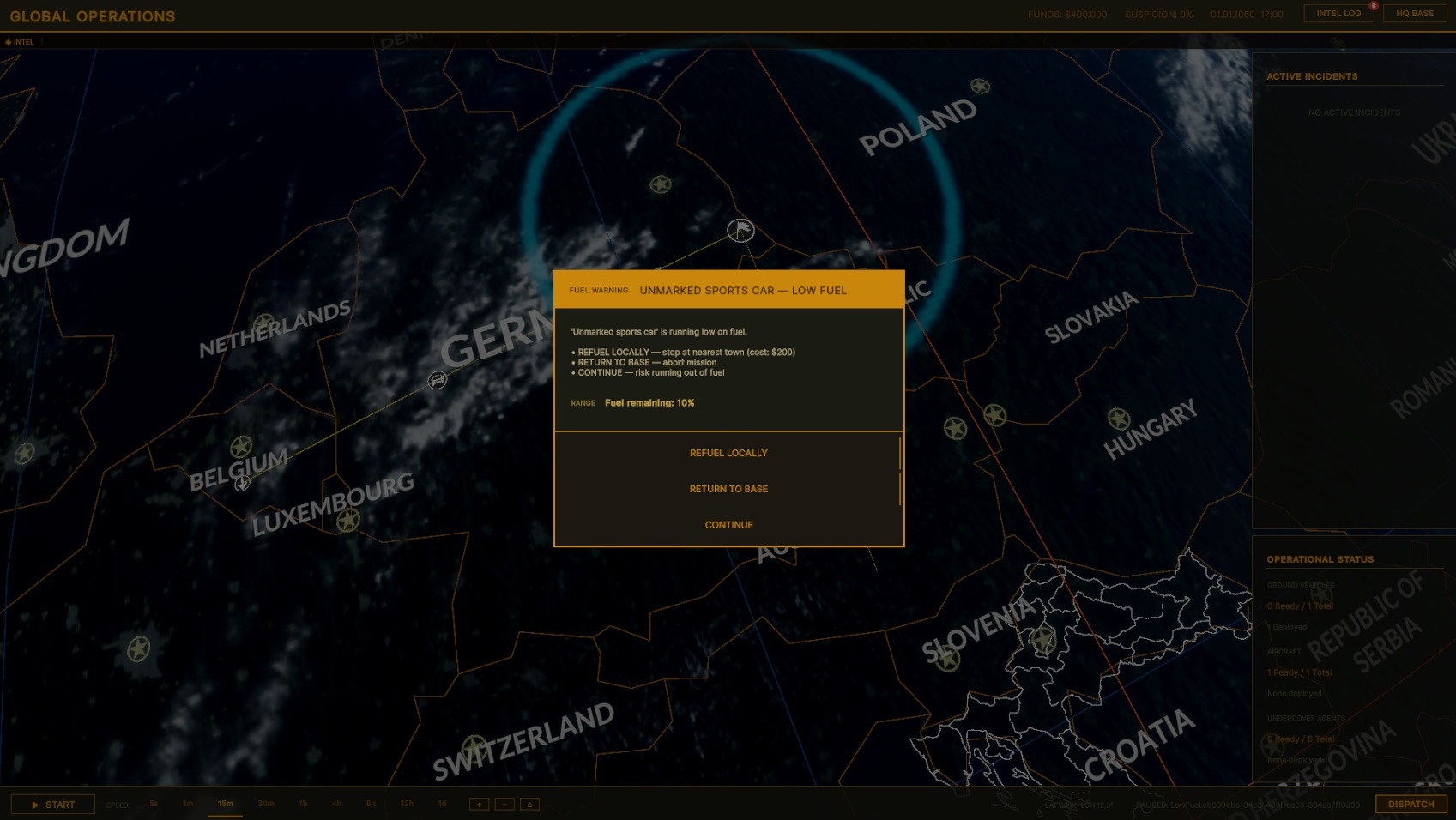
The World Is Watching. So Are We. The Globe layer is operational. That sentence is doing a lot of work, so let me be specific about what it actually means — because "operational" in ShadowOrg terms covers more ground ...
Read Full Report →
It Started With A Question What if you were the secret organisation? Not the soldier on the ground. Not the scientist piecing together the evidence. The person running the whole thing — the budget, the personnel, the...
Read Full Report →Secure channels are standing by.
PERSONNEL FILES — AUTHORISED DISCLOSURE
 GS
GS
The mind behind ShadowOrg. Designer, developer, and the person responsible for making sure the Cold War feels real enough to be unsettling. Building something that shouldn't exist — one system at a time.
[ NA ]
[ NA ]
[ Short description of what this person contributes to the project. ]